
Demo 08 — The reference pipeline without a network
The complete Pi-side geometry — calibration, segmentation, watershed, rectangle fit, tracking — on five synthetic scenes with known answers. Overlays included.
Needs: laptop, numpy, OpenCV. Without MetaTF the Akida pool runs as a stub and says so.
python3 tools/run_selftest.py --use-background --out selftest_out
Output we got:
[AkidaPool] Stub-Modus aktiv (MetaTF nicht installiert). Ergebnisse sind Platzhalter.
Szene       erwartet  erkannt   Status
free               2        2       OK   … 'segmentierung': 102.95, … 'gesamt': 116.16
    #1      89.8,   59.8 mm   80.0x22.0     11.7 deg  occ=0  vollstaendig sichtbar
    #2     209.8,  129.8 mm   80.0x22.0    105.7 deg  occ=0  vollstaendig sichtbar
    Lagefehler max 0.22 mm, Winkelfehler max 0.70 deg
touching           2        2       OK
overlap            2        2       OK
mixed              5        5       OK
stacked            1        1       OK
A5 Mittelpunktfehler median: 0.22 mm  (Ziel <= 1.00) OK
A4 Winkelfehler median:      0.33 deg (Ziel <= 3.00) OK
GESAMT: OK
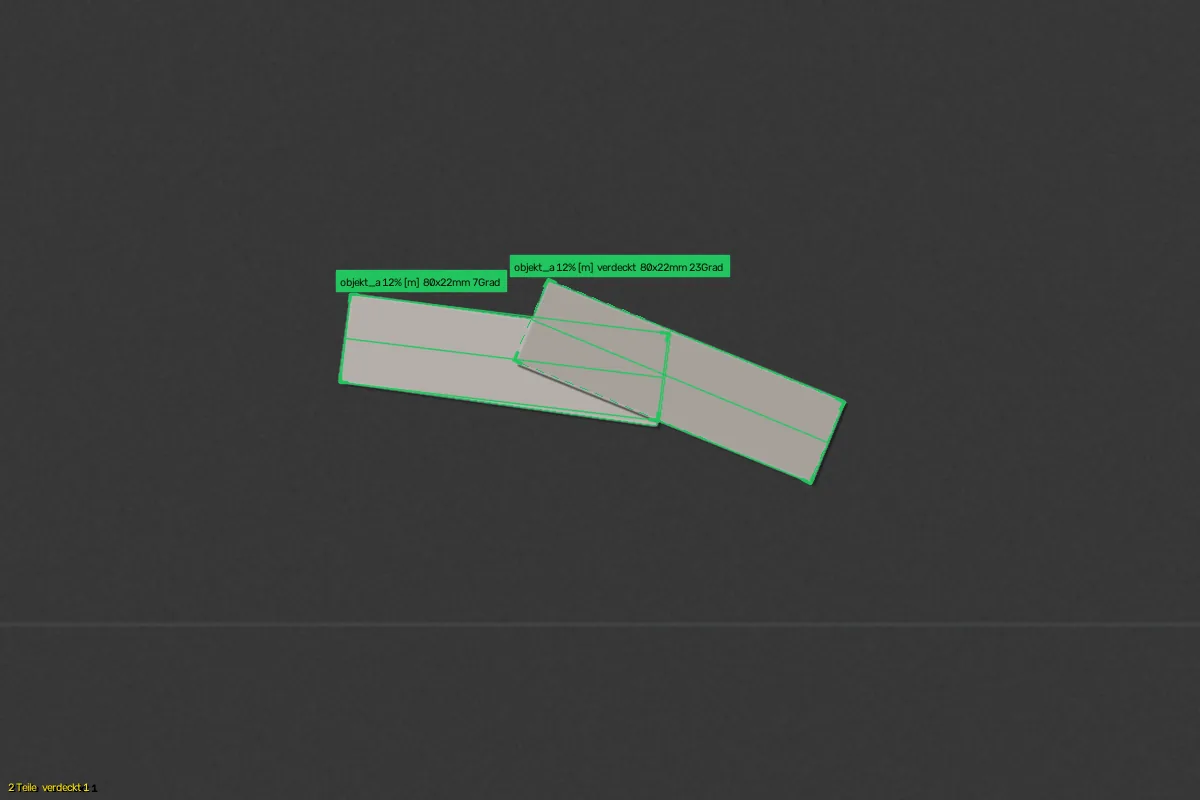
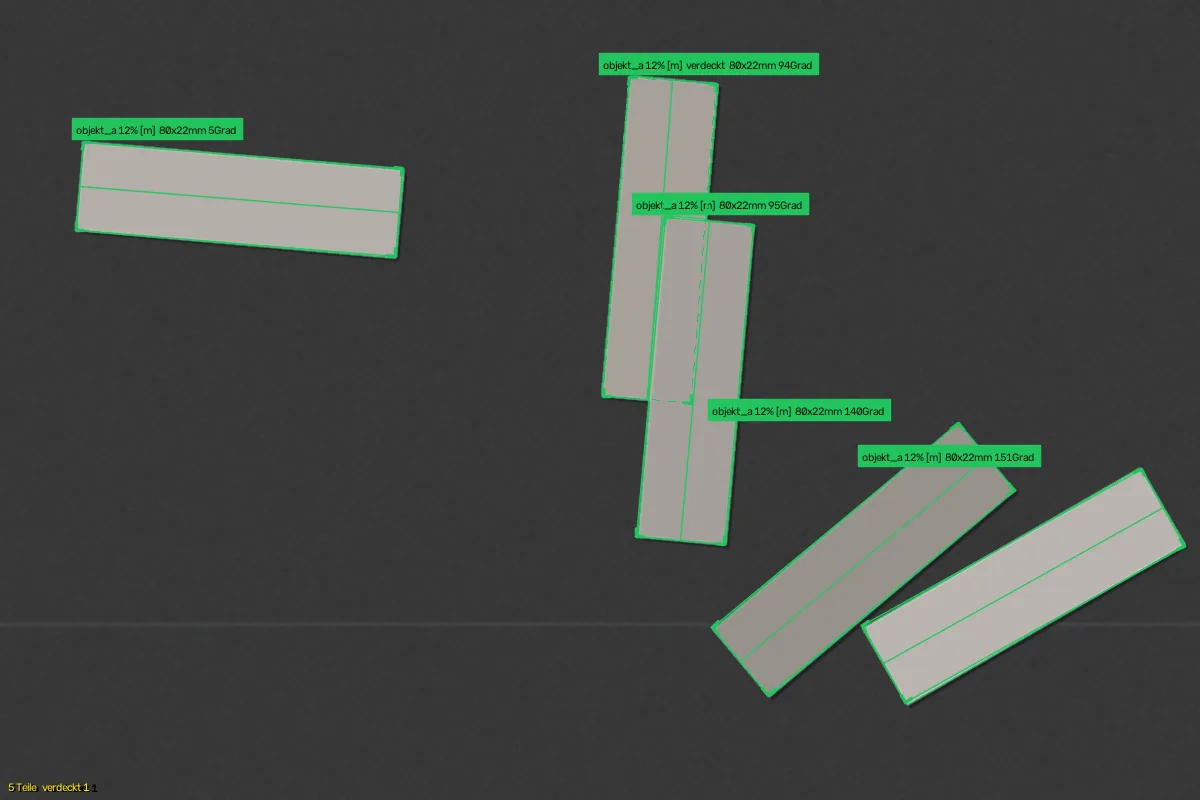
The "12 %" on the labels is the stub pool's deliberately flat confidence (1/C for 8 classes) — a placeholder that cannot be mistaken for a model result. [m] marks the origin of each frame (merged pieces), the dashed edges are reconstructed, the yellow footer line reports "2 Teile · verdeckt 1".
What the numbers mean
Five scenes with two to five 80 × 22 mm parts: free, touching (watershed separates them), overlapping (rectangle decomposition), mixed, and two parts stacked exactly on top of each other (correctly reported as one — a single frame cannot know). Median centre error 0.22 mm and angle error 0.33° against the generator's ground truth, ~15 ms per frame on the Pi (100–270 ms here on the x86 test machine with the stub; timings vary by scene).
The pipeline is the reference value for the energy comparison and the source of exactly annotated overlap images for training — not the model.
Proves
That the geometric chain introduces no error of its own under perfect calibration.
Does not prove
Anything about real belt images (calibration, lighting, motion blur).
Time: 3 minutes; the overlays land in selftest_out/.